Matching hardwood floors across several rooms is rarely as simple as selecting a stain from a color chart. The challenge becomes even greater when the project includes stair treads, landings, handrails, older flooring, and sections of wood that have aged differently.
In this Matthews, NC home, the goal was to create a more consistent appearance across the main floors and staircase. Some surfaces already had a rich, dark tone, while adjoining floorboards had been sanded back to much lighter, unfinished wood. The contrast made one thing clear: successful hardwood floor color matching would require more than applying the same stain everywhere.
To match hardwood floor stain professionally, contractors must evaluate the wood itself, prepare connected surfaces consistently, test colors on the actual floor, and account for how stairs and rooms reflect light differently. Here is what that process involves—and why careful preparation matters as much as the stain color.
Why Matching Hardwood Stain Is More Complicated Than It Looks
A stain color does not produce an identical result on every wood surface. Two boards treated with the same product can look noticeably different because of variations in species, grain, age, sanding, porosity, and previous treatments.
The difficulty increases when matching hardwood floors between rooms or coordinating a floor with a staircase. Stair treads may be made from different lumber, receive different levels of foot traffic, or have an older finish than the surrounding floors. Handrails can also appear darker because of their grain, shape, viewing angle, and repeated contact with hands.
Professional stain matching therefore begins with the existing wood—not with a color name on a can.
Several variables can influence the result. Wood species and grade affect how readily the surface accepts color, while grain patterns and mineral streaks create natural variation from board to board. Age and oxidation can deepen or warm an older floor, even after sanding.
Previous stain, sealer, wax, or finish also matters. So do the sanding sequence, final grit, water or pet staining, sun exposure, and the lighting inside the home. The selected finish and sheen can change how dark or reflective the color appears. Horizontal floors, stair treads, and curved handrails may therefore look slightly different even when they receive closely coordinated treatments.
The objective is visual continuity, not an artificial promise that every board will become exactly the same color.
The Challenge in This Matthews Hardwood Staining Project
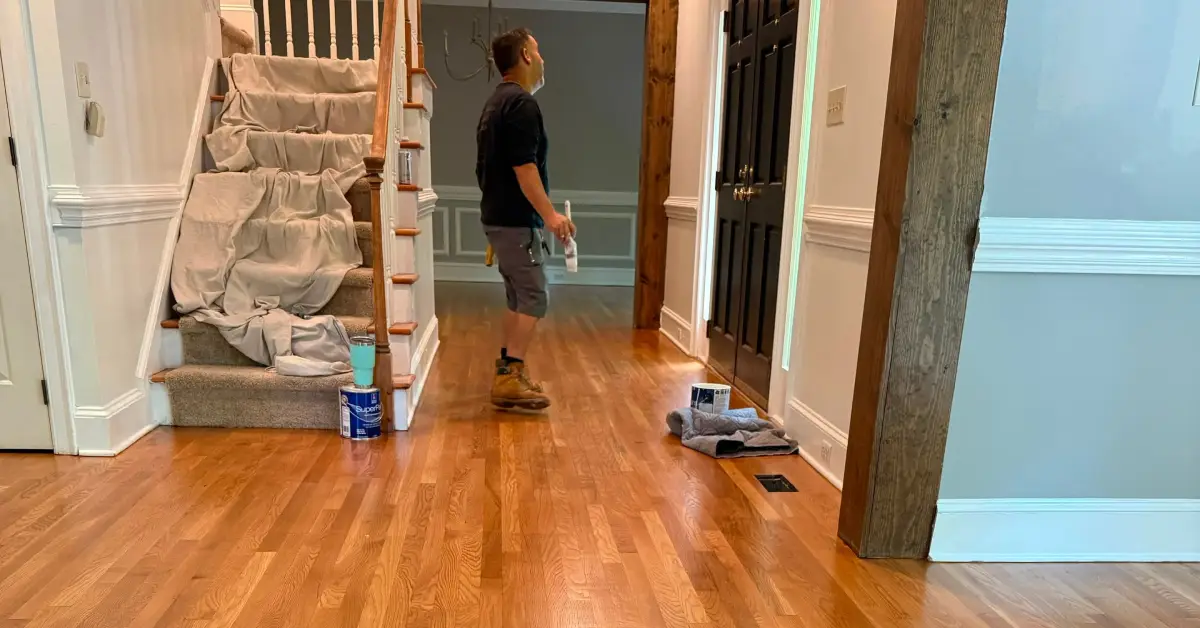
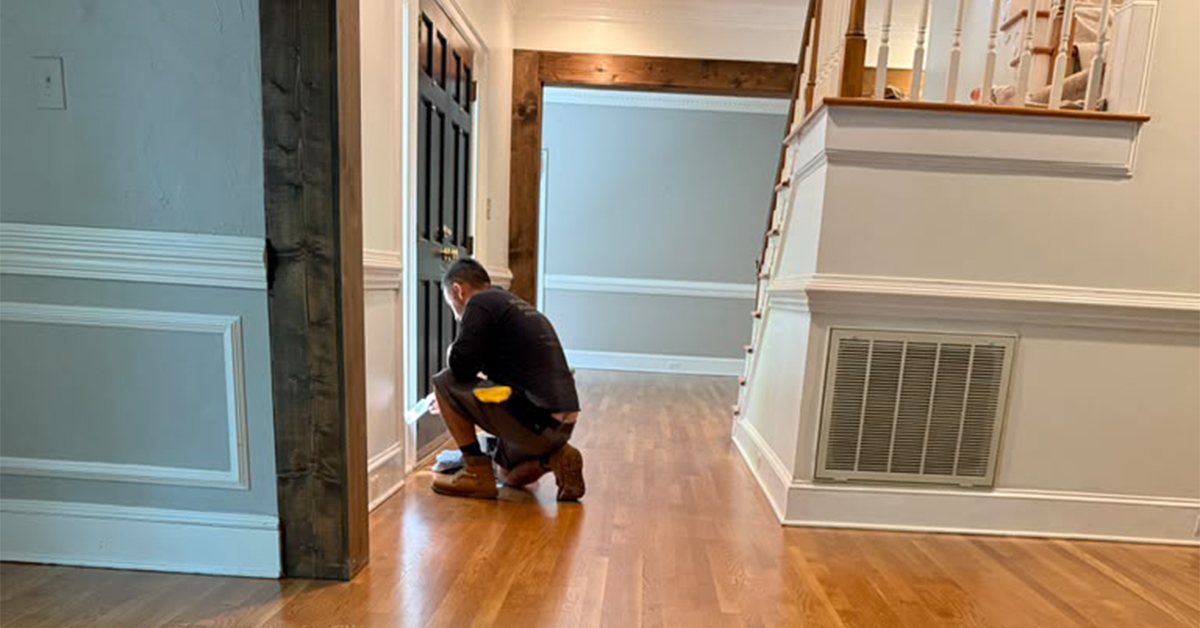
This home included hardwood flooring across an open, visually connected interior with a prominent staircase. The stair treads, landings, and portions of the surrounding floor already displayed a dark brown finish. During the project, the central flooring was sanded to reveal much lighter bare wood.
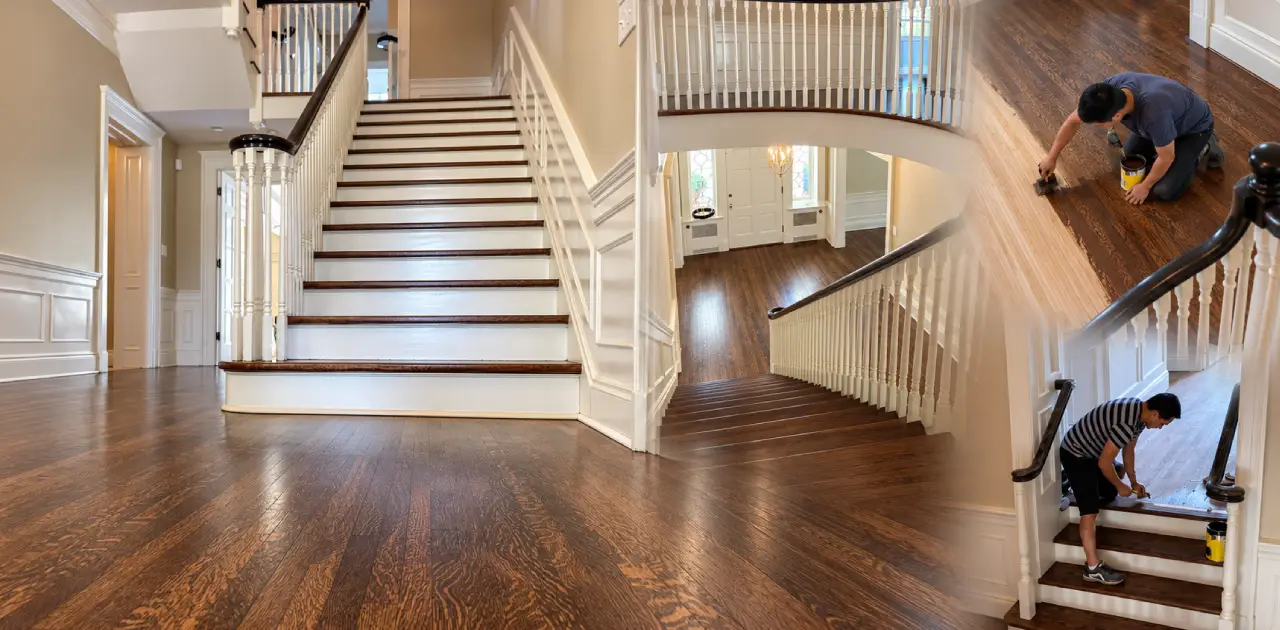
Because the staircase could be seen from multiple levels, any inconsistency would have been easy to notice. The new finish needed to coordinate across the main hardwood floor, adjacent rooms and doorways, stair treads, upper and intermediate landings, exposed flooring around the railing, and the dark-stained handrails.
This type of layout leaves few places to disguise a poor transition. A color that appears acceptable in one room may look too red, too dark, or too cool when viewed beside the stairs. The open foyer also exposes the wood to different amounts of daylight throughout the day.
That made on-site preparation and evaluation essential.
How Professionals Match Hardwood Floor Stain
A dependable stain-matching process combines material identification, controlled sanding, physical samples, and evaluation under the home’s actual lighting. Skipping any of these stages can create noticeable differences between connected surfaces.
1. Examine the Existing Wood and Finish
The first step is identifying what is already present.
A flooring professional evaluates the likely wood species, board width, grain pattern, existing color, and condition of the finish. The contractor also looks for evidence of previous coatings, repairs, replacement boards, and areas affected by sunlight or heavy traffic.
The evaluation establishes whether all the connected surfaces are the same species and whether certain areas were refinished more recently than others. It also helps determine how much of the existing color comes from stain and how much comes from natural aging.
The contractor must then consider whether wax, polish, or another contaminant could interfere with the new coating. Taken together, these findings show whether an isolated area can be matched successfully or whether refinishing a larger connected section is the more dependable option.
These findings determine whether stain matching existing wood floors is realistically achievable within a limited area.
2. Sand Connected Surfaces Consistently
Stain penetrates wood rather than simply sitting on top of it. The sanding process affects how deeply and evenly it is absorbed.
If one area is sanded to a different final grit than another, the same stain may look darker or lighter across the transition. Uneven sanding can also create visible scratches, swirl marks, or blotchy areas that become more obvious after a dark stain is applied.
Professional hardwood floor refinishing and sanding creates a more consistent surface before color is introduced. Contractors must pay particular attention to edges, corners, doorways, stair nosings, and the areas around balusters, where different sanding equipment may be required.
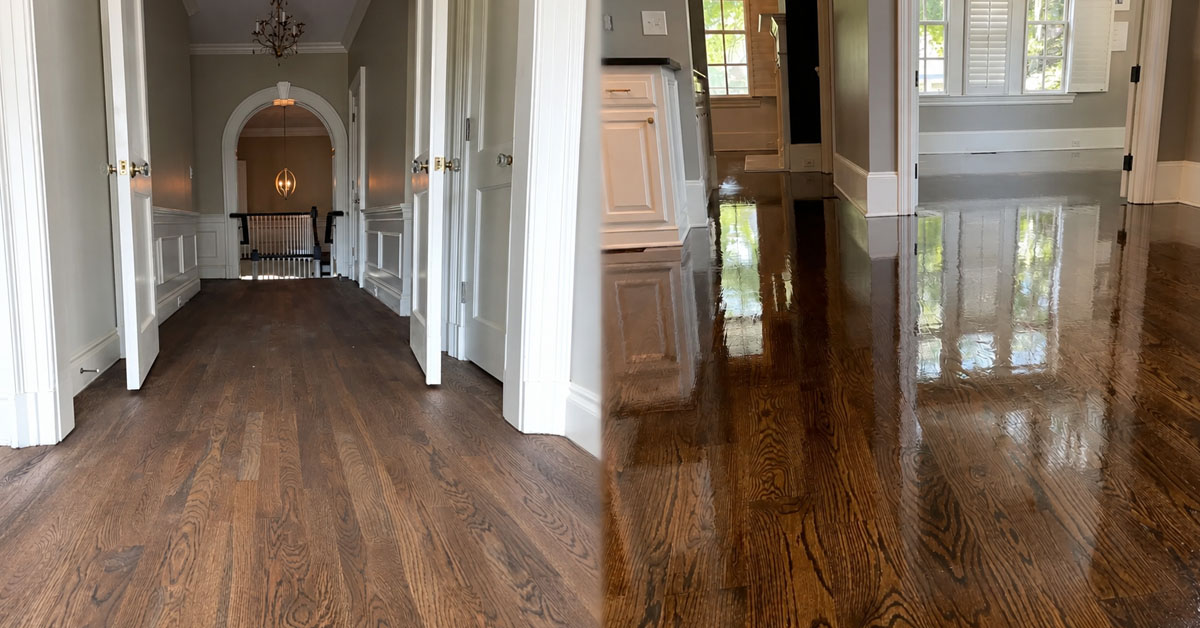
The photographs from this Matthews project show the contrast between the sanded central floor and the darker finished staircase. That preparation stage is critical: it creates a clean surface on which stain samples and final applications can be evaluated accurately.
3. Test Stain on the Actual Flooring
Printed samples and digital images are useful for narrowing the options, but they cannot reliably predict how a stain will react with a specific floor.
Professionals create test samples directly on the prepared wood or on representative pieces of the same species. Depending on the project, they may compare several colors, blends, or application methods.
A useful sample should extend across multiple boards so the homeowner can see natural grain variation and differences between the lighter and denser portions of the wood. It should also reveal whether the color carries red, brown, amber, or gray undertones. Whenever practical, the sample should account for the intended topcoat because the protective finish can add depth and change how the color reflects light.
Small samples can be misleading because they may capture only one grain pattern. Testing across several boards provides a more realistic view of the finished room.
Homeowners should evaluate these samples from standing height—not only while kneeling beside the floor.
4. Review the Color in Different Lighting
Hardwood stain can look dramatically different under daylight, warm interior bulbs, cool LEDs, and evening lighting.
In an open home with multiple levels, one section may receive strong window light while another remains shaded. Dark brown flooring may look warmer near a sunny entry and cooler along an interior staircase, even when the underlying stain is the same.
Professionals review stain samples from several positions and at different times when possible. They also compare the sample directly against the existing stair treads, landings, nearby rooms, cabinetry, and trim.
This is one reason hardwood staining should be selected inside the home rather than solely in a showroom.
5. Coordinate the Floor, Stair Treads and Handrails
Matching stair stain to hardwood floors requires visual judgment. Stair treads and flooring do not always absorb stain identically, even when they appear to be the same species.
The treads may contain different grain patterns or lumber grades. Their vertical arrangement also changes how light strikes them. Rounded nosings can appear lighter along one edge and darker along another.
Handrails create an additional challenge. Their curved profile, close-set grain, and viewing angle often make the color appear deeper than it does on a flat floor.
The aim is for all these elements to feel intentional together. That does not always require an identical formula on every component. In some cases, a professional may adjust preparation or color application so that different wood surfaces produce a coordinated final appearance.
Majestic’s hardwood floor staining service can address these connected surfaces as part of one coordinated plan.
6. Apply the Finish and Match the Sheen
Stain establishes the color, but the protective finish affects how that color is perceived.
A glossier finish reflects more light and may make a surface appear richer or darker from certain angles. Satin and matte finishes usually create softer reflections, although the final effect depends on the product and number of coats.
Using a consistent compatible finish across floors, landings, and stair treads helps unify the completed project. Application thickness, drying conditions, and abrasion between coats must also remain controlled.
This matters especially in an open staircase, where reflected light makes sheen differences more visible.
When an Exact Stain Match May Not Be Possible
A reputable flooring contractor should explain the limits of matching before work begins.
An exact match may not be realistic when connected surfaces are made from different wood species or the existing flooring has faded unevenly. Deep pet or water stains can also affect how individual boards respond after sanding.
Other complications include previous coatings that cannot be removed uniformly, replacement boards that have not aged like the original floor, and an existing stain formula that is unknown or discontinued. Older wood may also have developed a natural patina that new material cannot immediately reproduce.
In these situations, refinishing a larger connected area may provide a more cohesive result than attempting a small spot match. Another option is to use a deliberate transition at a doorway or architectural break rather than forcing two visibly different floors to appear identical.
The right approach depends on the home, the condition of the wood, and how directly the surfaces can be seen together.
Why Professional Stain Matching Can Protect the Final Result
Correcting a poor stain match usually requires more than adding another coat. Once a color has penetrated the wood and been sealed, changing it may involve sanding the surface again.
Professional planning reduces the risk of abrupt color changes between rooms or a staircase that appears unrelated to the floor. It also helps prevent dark edges, light centers, blotchy absorption, visible sanding marks, incompatible finishes, and unexpected undertones. Most importantly, careful sampling can reduce the likelihood of paying to sand and redo an area after the work has been completed.
It can also help homeowners make decisions before furniture is moved, schedules are finalized, and large areas of flooring are treated.
For a project involving floors and stairs, coordinating hardwood staircase work with refinishing and staining produces a more deliberate result than treating each surface as an unrelated project.
Questions to Ask Before Approving a Stain
Before selecting the final color, ask your flooring contractor:
- Will samples be applied to the actual floor?
- Are the floors and stair treads the same species?
- Which connected areas need to be sanded?
- Will the finish change how the sample looks?
- Can the existing color be matched, or only coordinated?
- How will replacement boards react to the stain?
- What sheen will be used on floors and stairs?
- Where will any unavoidable transitions occur?
- When can the finished surface be walked on?
- How should the floor be maintained after curing?
Clear answers help align expectations before the stain is applied.
Frequently Asked Questions
Can new hardwood be stained to match an older floor?
Often, yes, but the result depends on species, age, grain, existing color, and finish. New boards may absorb stain differently from older wood. On-site samples are the most reliable way to determine how closely the surfaces can be coordinated.
Should stairs be exactly the same color as the hardwood floor?
They should generally look cohesive, but a perfect formula-for-formula match is not always necessary or possible. Grain, lighting, tread construction, and handrail profiles can make the same stain appear different. Professional matching focuses on a visually balanced result.
Do adjoining rooms need to be refinished together?
Not always. A natural stopping point such as a doorway may allow one room to be completed separately. Open layouts and uninterrupted boards are less forgiving, so refinishing the connected surfaces together may produce a better transition.
Why does stain look different after the finish is applied?
A protective topcoat changes how light reflects from the wood. It can increase depth, emphasize warmth, and alter the apparent darkness of the stain. Samples should account for the planned finish whenever possible.
How long does professional stain matching take?
The schedule depends on the project size, required repairs, sanding, sample approval, stain application, number of finish coats, and curing requirements. An in-home assessment provides a more reliable timeline than a general estimate.
Create a Consistent Finish Throughout Your Matthews Home
Matching hardwood floors between rooms and staircases takes more than finding a similarly named stain. The wood must be evaluated, prepared consistently, sampled in place, examined under real lighting, and finished with attention to both color and sheen.
That process was especially important in this Matthews project because the floors, landings, treads, and handrails could be viewed together from several levels. Careful coordination allowed the connected wood surfaces to feel like part of one home rather than separate projects completed at different times.
Trying to match existing hardwood floors, stairs, or newly renovated rooms? Contact Majestic Hardwood Floors to schedule an in-home stain-matching consultation. We can evaluate the wood, existing color, lighting, and connected surfaces before recommending the most appropriate path forward.